In this artwork, the letter M becomes a meeting place between the visible hand and an invisible story of origin.
The palms are imagined as a living manuscript: the body carries a reminder of something it cannot fully contain. “Spirit bound in flesh” names that tension. Within this project interpretation, gnosis is remembrance—a turning of attention from appearances toward the Source.
This is a symbolic reading of the hand. The claim that the Monad imprinted its initial in both palms before birth is not established by the ancient passages cited here, nor is a palm pattern scientific evidence of spiritual origin. The association of M with Monad, Mother, Mystery and return belongs to the artwork’s modern contemplative vocabulary.
The Apocryphon of John describes the Monad as the supreme principle, beyond the lower powers. Calling every individual self “the Monad” is an interpretive extension in this artwork, not a definition shared by every ancient tradition. Read source 1 ↗
“False heavens,” imprisonment and return are theological and artistic motifs here. They are not presented as a measured description of the physical universe. The project can explore their meaning without treating all Gnostic, Hermetic and other religious traditions as a single system.
The original revised artwork
The journey, at a glance.
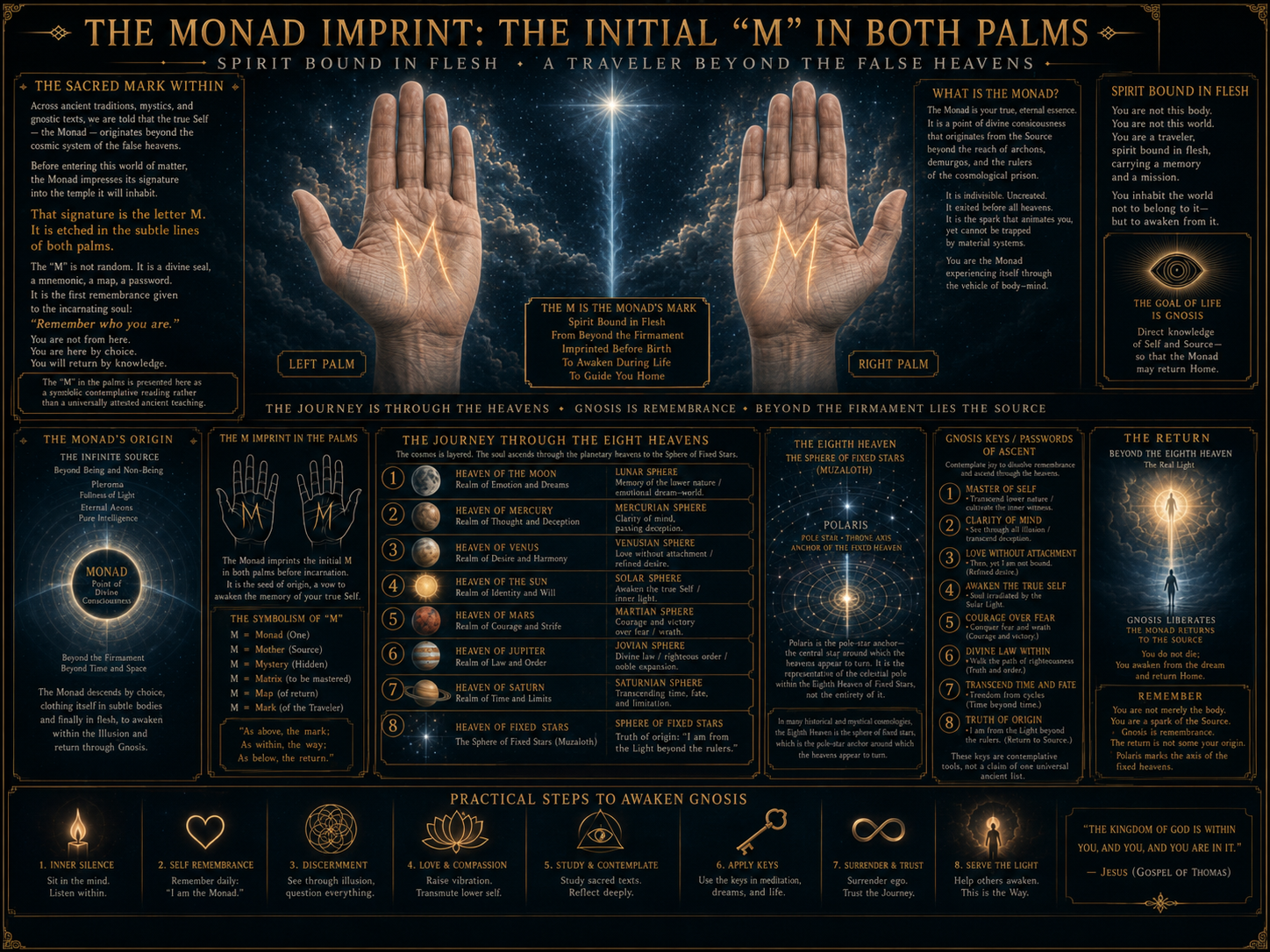
Read the artwork’s attribution notes
The closing sentence attributed to Jesus in the image is not a verified verbatim quotation from the Gospel of Thomas. Compare sayings 3 and 77 for related kingdom and light imagery. Its title “Muzaloth” is not used here as a universal name for the eighth heaven: heaven names and arrangements depend on the specific text and tradition. The eight keys below are modern reflections, not authenticated ancient formulas.
A cinematic meditation
Stillness. Light. Orientation.
A ten-second visual interlude: aged brass, an enclosing canopy and an axial light.
AI-generated artistic interpretation. This imagined instrument is a visual meditation, not an ancient artifact or a scientific reconstruction.
02 / The ascent
Eight stages.
One contemplative journey.
A modern synthesis uses the familiar planetary order as a structure for reflection. Select a sphere to explore its theme.
Comparative / modern synthesis — not universal Gnostic passwords
Moon · modern contemplative key
Mastery of self
Notice the difference between a passing feeling and the awareness that observes it.
Ancient ascent traditions do not supply one interchangeable set of seven or eight passwords. Names, responses, seals, rites and cosmic arrangements belong to particular texts. Moving a formula from one work into another planetary map creates a new comparison; it does not recover a universal ancient manual.
For example, Gospel of Thomas saying 50 presents questions about origin, identity and a sign of the father, including an answer about coming from light. It does not assign eight answers to eight planetary gates. The Hermetic Discourse on the Eighth and Ninth presents a teacher-guided visionary ascent of its own. Compare sources 2 and 3 ↗
Here, the artwork’s keys become prompts for self-examination: discernment, compassion, courage, integrity and remembrance. They are not guaranteed methods of reaching an afterlife realm. “Return” expresses the project’s spiritual and artistic aspiration.
The distinction that matters
Polaris is an axial marker.
The eighth heaven is the stellar sphere.
The sphere of fixed stars
In the Aristotelian-Ptolemaic system, the eighth sphere surrounds the seven planetary heavens. “Fixed” refers to the stars’ relative arrangement in that model, not to a sky that never appears to move. Other traditions count and describe heavens differently. Source 4 ↗
A direction in the sky
Polaris lies near the north celestial pole. Stars appear to circle that pole as Earth rotates. Polaris is not exactly at the pole, and precession changes which star serves as the North Star over long periods. It is not the whole stellar sphere. Source 5 ↗
03 / Read the sources
Keep the threads distinct.
Textual witnesses, historical models and scientific explanations support different kinds of statements. These links are reading anchors, not proof of the artwork’s palm-seal interpretation.
- 01Ancient text · opening revelation
The Apocryphon of John
Frederik Wisse translation. The supreme principle is called the Monad; the narrative also describes lower rulers. This does not establish an M-shaped palm seal.
- 02Ancient text · sayings 3, 50 and 77
The Gospel of Thomas
Thomas O. Lambdin translation. Compare self-knowledge, origin in light, and light imagery. Saying 50 is not a planet-by-planet password table.
- 03Hermetic text · opening dialogue
The Discourse on the Eighth and Ninth
James Brashler, Peter A. Dirkse and Douglas M. Parrott translation. A teacher guides a visionary ascent. Its eighth and ninth must not be automatically equated with every other heaven system.
- 04History of astronomy · Museo Galileo
Fixed stars
Identifies the eighth sphere of the Aristotelian-Ptolemaic system as the heaven of fixed stars surrounding the planetary heavens.
- 05Astronomy · NASA
What is the North Star?
Explains Polaris near the north celestial pole, apparent star motion as Earth rotates, and the change of pole stars through precession.